CELL MODEL DATASHEET

Human iPSC-Derived Hepatocytes

Human iPSC-Derived Hepatocytes

Mature, polarised, diverse-donor hepatocytes for hepatic safety, metabolism and disease modelling.

Cytochroma human iPSC-derived hepatocytes are cryopreserved hepatocyte-like cells differentiated from a panel of ancestrally and genetically diverse, HLA-typed human induced pluripotent stem cell lines. They reach greater than 95% purity, ship at a minimum of 5 million cells per vial, and display adult hepatocyte physiology: cobblestone morphology, binucleation, visible bile canaliculi, albumin secretion, and both basal and drug-inducible cytochrome P450 activity. Because every line in the panel is genotyped, the same assay can be run across donors of different ancestry, sex and HLA type to capture the inter-individual variability that single-donor and immortalised models miss.

8 / 18

donor lines fully HLA-typed

97.9%

recorded post-thaw viability

≥5M

viable cells per vial

10+ days

stable phenotype in monolayer

Why this model

Industry-leading donor diversity

The largest HLA-typed, iPSC-derived hepatocyte library commercially available, built from an iPSC library that maps to ancestral markers of European, Native American and African populations, with a 1:1 female to male balance.

Mature and polarised, not fetal-like

Authentic cobblestone morphology, binucleation and bile canaliculi, supporting transporter and efflux studies that flat, immature hepatocyte models cannot address.

Renewable and reproducible

Off-the-shelf or custom lines from a defined iPSC library. Consistent batch supply without the lot-to-lot scarcity and donor variability of primary human hepatocytes.

specifications


Cell type

Human iPSC-derived hepatocytes (iHeps)

Purity

Greater than or equal to 95% hepatocyte identity

Viable cells per vial

Greater than or equal to 5 x 10⁶

Post-thaw viability

97.9% (line MAN-010-2H, automated high-content workflow)

Format

Cryopreserved

Morphology

Cobblestone, binucleation, bile canaliculi

Secreted markers

High albumin (confirmed by immunostaining)

Cytochrome P450

Basal and inducible activity; CYP1A2 induction by omeprazole confirms intact AhR-mediated regulation; 2.27x CYP3A4 induction demonstrated in mature differentiated cells

Phenotype stability

10+ days in monolayer; weeks to months in 3D culture

Donor panel

8 of 18 lines fully HLA-typed at two-field resolution; 71 distinct HLA alleles; 1:1 female to male

Disease-model readiness

MAFLD, MASH, fibrosis, microtissue and hepatotoxicity

Manufactured in

Roslin Innovation Centre, Edinburgh, United Kingdom

Phenotype and imaging

Representative immunofluorescence from Cytochroma production batches. Full imaging data and batch-specific Certificates of Analysis are available on request.


Immunofluorescence micrograph of Cytochroma human iPSC-derived hepatocytes stained for albumin in green with nuclei counterstained blue, showing cobblestone morphology and frequent binucleation. Albumin immunostaining (green) with nuclear counterstain (blue). Cobblestone morphology and binucleate cells are hallmarks of mature hepatocyte identity, not the flat, fetal-like phenotype typical of immature iPSC-hepatocyte protocols.

Albumin immunostaining (green) with nuclear counterstain (blue). Cobblestone morphology and binucleate cells are hallmarks of mature hepatocyte identity, not the flat, fetal-like phenotype typical of immature iPSC-hepatocyte protocols

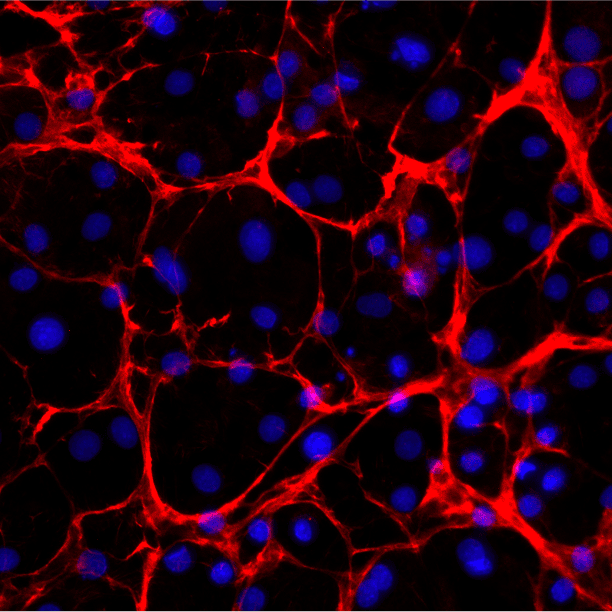
Bile canalicular network visualised by MRP1 immunostaining (red) between adjacent hepatocytes. Visible canaliculi indicate apical–basal polarisation, which is what makes hepatic transporter and efflux studies physiologically meaningful

Bile canalicular network visualised by MRP1 immunostaining (red) between adjacent hepatocytes. Visible canaliculi indicate apical–basal polarisation, which is what makes hepatic transporter and efflux studies physiologically meaningful.

Lipid-loaded hepatocytes in the MAFLD/MASH model. Neutral lipid droplets (green) are quantified by high-content imaging as total lipid area and droplet size. CYP450 function is maintained throughout disease induction.

Lipid-loaded hepatocytes in the MAFLD/MASH model. Neutral lipid droplets (green) are quantified by high-content imaging as total lipid area and droplet size. CYP450 function is maintained throughout disease induction

Applications

  • Drug-induced liver injury (DILI) and hepatotoxicity screening

  • MAFLD and MASH disease modelling with quantifiable steatosis by high-content imaging

  • Cytochrome P450 induction, inhibition and metabolic stability studies

  • Hepatic transporter and efflux studies in polarised cells

  • Ancestry-stratified and donor-specific toxicity panels for AI drug discovery

  • Cell Painting and multiplexed high-content phenotypic profiling

  • 3D microtissue and co-culture models with Kupffer cells and hepatic stellate cells

Donor diversity and HLA typing

Every Cytochroma cell model is differentiated from an induced pluripotent stem cell library built deliberately for population-level variability rather than convenience. 8 of 18 of 18 iPSC donor lines fully HLA-typed at two-field resolution. 71 distinct HLA alleles across the panel. 1:1 female to male donor balance. European, Native American and African ancestry represented. Pairwise HLA mismatch scores of 7 to 10 out of 10 between almost every donor pair, across HLA-A, B, C, DRB1 and DQB1.

Typing covers the classical class I loci HLA-A, HLA-B and HLA-C and the class II loci DRB1, DRB3/4/5, DQA1, DQB1, DPA1 and DPB1 at two-field resolution. Full multi-field typing is available on request. Because almost every donor pair scores 7 to 10 out of 10 on pairwise allele-level mismatch, donor-mismatched co-culture, allogeneic response and HLA-restriction studies can be set up off the shelf.

Evidence and validation

Peer-reviewed MASH application

Lipid-loaded Cytochroma hepatocytes recapitulated the transcriptional and metabolic dysregulation of MAFLD/MASH, discriminated target-selective Cyclophilin B over Cyclophilin A inhibitors, and gave compound potency comparable to FDA-approved resmetirom. Published as Optimization of Cyclophilin B-Targeted Tri-vector Inhibitors for Novel MASH Treatments, Journal of Medicinal Chemistry 2025, 68(6), 6815 (DOI 10.1021/acs.jmedchem.5c00301), with the University of Edinburgh.

Automated functional validation

Line MAN-010-2H was differentiated and benchmarked through a fully automated high-content screening workflow at a specialist contract research partner: 97.9% post-thaw viability, a multiplexed Cell Painting assay resolving distinct mechanisms of toxicity across a panel of 8 compounds, and a stable staurosporine dose-response from 12 to 48 hours (pIC50 5.3 to 6.2, signal-to-background 2.55). Automated seeding roughly halved well-to-well assay variability.

Multi-donor CYP450 profiling

Diverse-donor iHeps express key CYP450 enzymes with functionally relevant induction and reproducible donor-dependent variability, unlike HepG2 or short-lived primary hepatocytes.

Consortium participation

Cytochroma is the Advanced Liver Partner to the HESI OASIS consortium, convened by HESI Global and the Broad Institute of Harvard and MIT, contributing diverse-donor human liver models to its hepatic-safety programme.


“Their hepatocyte MASH models helped us quickly evaluate novel inhibitors in a biologically relevant model, essential data for our J. Med. Chem. publication.”

Dr Dahlia Doughty-Shenton, University of Edinburgh

OASIS Consortium

Cytochroma is an Advanced Liver Partner in the OASIS Consortium (’Omics for Assessing Signatures for Integrated Safety), a pre-competitive hepatic-safety consortium convened in July 2023 by HESI Global and the Broad Institute of Harvard and MIT as a working group of HESI’s eSTAR committee. OASIS integrates transcriptomics, proteomics and high-content Cell Painting across human-relevant models, with an initial focus on liver safety, and spans more than 160 experts across 17 academic institutes, 7 government agencies, 17 industry organisations and 3 NGOs. Cytochroma contributes diverse-donor human liver models to the consortium’s hepatic-safety programme. See The OASIS Consortium: Integrating Multi-Omics Technologies to Transform Chemical Safety Assessment, Rouquié et al., Toxicological Sciences 2025, 208(2), 225 (DOI 10.1093/toxsci/kfaf128).

Applications

  • Drug-induced liver injury (DILI) and hepatotoxicity screening

  • MAFLD and MASH disease modelling with quantifiable steatosis by high-content imaging

  • Cytochrome P450 induction, inhibition and metabolic stability studies

  • Hepatic transporter and efflux studies in polarised cells

  • Ancestry-stratified and donor-specific toxicity panels for AI drug discovery

  • Cell Painting and multiplexed high-content phenotypic profiling

  • 3D microtissue and co-culture models with Kupffer cells and hepatic stellate cells

Donor diversity and HLA typing

Every Cytochroma cell model is differentiated from an induced pluripotent stem cell library built deliberately for population-level variability rather than convenience. 8 of 18 of 18 iPSC donor lines fully HLA-typed at two-field resolution. 71 distinct HLA alleles across the panel. 1:1 female to male donor balance. European, Native American and African ancestry represented. Pairwise HLA mismatch scores of 7 to 10 out of 10 between almost every donor pair, across HLA-A, B, C, DRB1 and DQB1.

Typing covers the classical class I loci HLA-A, HLA-B and HLA-C and the class II loci DRB1, DRB3/4/5, DQA1, DQB1, DPA1 and DPB1 at two-field resolution. Full multi-field typing is available on request. Because almost every donor pair scores 7 to 10 out of 10 on pairwise allele-level mismatch, donor-mismatched co-culture, allogeneic response and HLA-restriction studies can be set up off the shelf.

Evidence and validation

Peer-reviewed MASH application

Lipid-loaded Cytochroma hepatocytes recapitulated the transcriptional and metabolic dysregulation of MAFLD/MASH, discriminated target-selective Cyclophilin B over Cyclophilin A inhibitors, and gave compound potency comparable to FDA-approved resmetirom. Published as Optimization of Cyclophilin B-Targeted Tri-vector Inhibitors for Novel MASH Treatments, Journal of Medicinal Chemistry 2025, 68(6), 6815 (DOI 10.1021/acs.jmedchem.5c00301), with the University of Edinburgh.

Automated functional validation

Line MAN-010-2H was differentiated and benchmarked through a fully automated high-content screening workflow at a specialist contract research partner: 97.9% post-thaw viability, a multiplexed Cell Painting assay resolving distinct mechanisms of toxicity across a panel of 8 compounds, and a stable staurosporine dose-response from 12 to 48 hours (pIC50 5.3 to 6.2, signal-to-background 2.55). Automated seeding roughly halved well-to-well assay variability.

Multi-donor CYP450 profiling

Diverse-donor iHeps express key CYP450 enzymes with functionally relevant induction and reproducible donor-dependent variability, unlike HepG2 or short-lived primary hepatocytes.

Consortium participation

Cytochroma is the Advanced Liver Partner to the HESI OASIS consortium, convened by HESI Global and the Broad Institute of Harvard and MIT, contributing diverse-donor human liver models to its hepatic-safety programme.


“Their hepatocyte MASH models helped us quickly evaluate novel inhibitors in a biologically relevant model, essential data for our J. Med. Chem. publication.”

Dr Dahlia Doughty-Shenton, University of Edinburgh

OASIS Consortium

Cytochroma is an Advanced Liver Partner in the OASIS Consortium (’Omics for Assessing Signatures for Integrated Safety), a pre-competitive hepatic-safety consortium convened in July 2023 by HESI Global and the Broad Institute of Harvard and MIT as a working group of HESI’s eSTAR committee. OASIS integrates transcriptomics, proteomics and high-content Cell Painting across human-relevant models, with an initial focus on liver safety, and spans more than 160 experts across 17 academic institutes, 7 government agencies, 17 industry organisations and 3 NGOs. Cytochroma contributes diverse-donor human liver models to the consortium’s hepatic-safety programme. See The OASIS Consortium: Integrating Multi-Omics Technologies to Transform Chemical Safety Assessment, Rouquié et al., Toxicological Sciences 2025, 208(2), 225 (DOI 10.1093/toxsci/kfaf128).

Frequently asked questions

What are human iPSC-derived hepatocytes?
Are the donor lines HLA-typed?
Can these hepatocytes be used for MASH and MAFLD models?
Where are Cytochroma cells manufactured?

Request a quote or technical discussion

Tell us your assay format, donor requirements, and timelines. Our scientific team will help select the right donor panel and model configuration.