CELL MODEL DATASHEET

Human iPSC-Derived Cardiomyocytes

Human iPSC-Derived Cardiomyocytes

Diverse-donor cardiomyocytes for cardiac safety pharmacology and disease modelling.

Cytochroma human iPSC-derived cardiomyocytes are differentiated from the same ancestrally and genetically diverse, HLA-typed induced pluripotent stem cell library that underpins the Cytochroma hepatic range. Cardiac liability is one of the two leading causes of drug attrition alongside hepatotoxicity, and susceptibility to drug-induced arrhythmia varies with genetic background. Running cardiac safety assays across a panel of genotyped donors of different ancestry and sex surfaces that variability before it appears in the clinic, rather than after.

8 / 18

donor lines fully HLA-typed

71

distinct HLA alleles across the panel

1:1

female to male donor balance

3

Mapped to 3 ancestry groups

Why this model

ISame donor library, two organs

Cardiomyocytes and hepatocytes from the same genotyped donor allow paired cardiac and hepatic safety assessment in one genetic background, including metabolite-driven cardiac liabilities.

Diversity where it matters most

Proarrhythmic risk and repolarisation reserve differ by sex and genetic background. A 1:1 female to male, multi-ancestry panel tests that directly.

HLA-typed for immune-relevant work

The donor library is HLA-typed at two-field resolution, supporting allogeneic and immune-relevant cardiac studies off the shelf.

specifications


Cell type

Human iPSC-derived cardiomyocytes

Donor panel

8 of 18 lines fully HLA-typed at two-field resolution; 71 distinct HLA alleles; 1:1 female to male

Ancestry

European, Native American and African ancestry represented

Post-thaw viability

Acceptance ≥ 70%; 91.5% recorded for lot MAN021-30C

Format

Cryopreserved, 1.0 mL per vial; store at or below -145 °C; 12 months from receipt

Identity markers

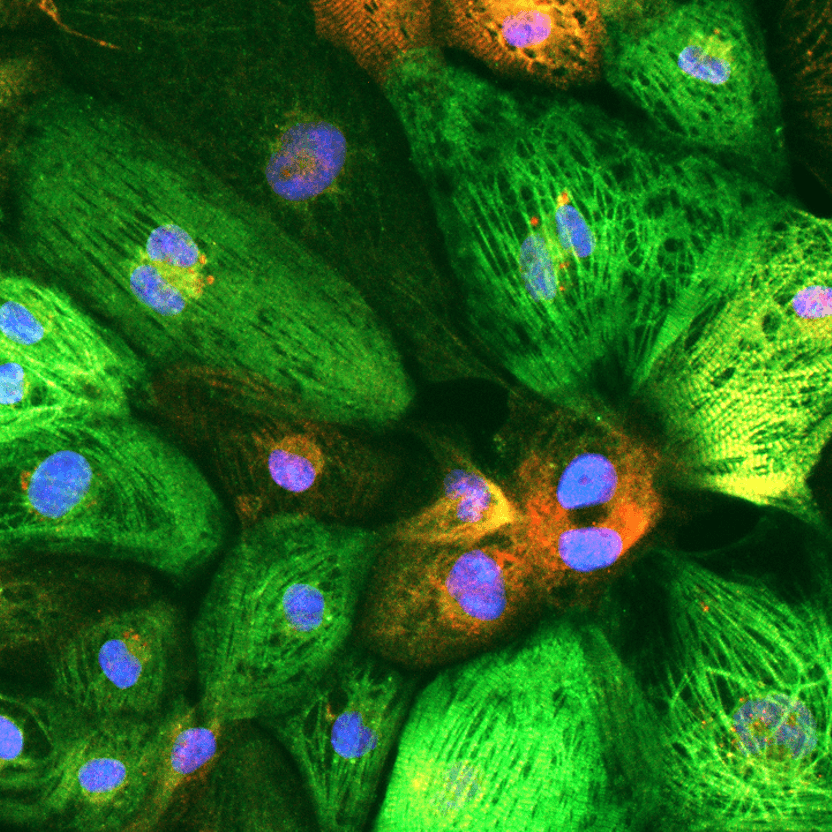
Cardiac troponin T (cTnT) and Nkx2.5 detected by immunofluorescence; polygonal morphology confirmed by microscopy at QC4. Striated sarcomeric cTnT organisation shown below.

Functional characterisation

Spontaneous contractile activity quantified at QC4: 22.7 ± 2.3 beats per minute by microscopy. Adherent cells confirmed at 24 hours post-thaw.

Documentation

Certificate of Analysis with every lot: viability, viable recovery, mycoplasma (MycoAlert, ratio less than 1.0), bacterial and fungal sterility, adherence at 24 hours, morphology, spontaneous contraction rate and cTnT/Nkx2.5 staining.

Sterility and mycoplasma

Mycoplasma negative by MycoAlert activity assay (ratio less than 1.0); bacteria and fungi negative by visual assessment at QC4

Manufactured in

Roslin Innovation Centre, Edinburgh, United Kingdom

Phenotype and imaging

Representative immunofluorescence from Cytochroma production batches. Full imaging data and batch-specific Certificates of Analysis are available on request.


Immunofluorescence micrograph of Cytochroma human iPSC-derived hepatocytes stained for albumin in green with nuclei counterstained blue, showing cobblestone morphology and frequent binucleation. Albumin immunostaining (green) with nuclear counterstain (blue). Cobblestone morphology and binucleate cells are hallmarks of mature hepatocyte identity, not the flat, fetal-like phenotype typical of immature iPSC-hepatocyte protocols.

Ventricular myosin light chain 2 (MLC2v) in green, showing organised sarcomeric striations with nuclei in blue. Striated cTnT is the standard identity and maturity marker for ventricular cardiomyocytes.

Applications

  • Cardiac safety pharmacology and proarrhythmia screening

  • Structural cardiotoxicity assessment for oncology compounds

  • Donor-stratified and sex-stratified cardiac risk panels

  • Cardiac disease modelling

  • Co-culture with iPSC-derived cardiac fibroblasts

  • High-content imaging and phenotypic profiling

Donor diversity and HLA typing

Every Cytochroma cell model is differentiated from an induced pluripotent stem cell library built deliberately for population-level variability rather than convenience. 8 of 18 of 18 iPSC donor lines fully HLA-typed at two-field resolution. 71 distinct HLA alleles across the panel. 1:1 female to male donor balance. European, Native American and African ancestry represented. Pairwise HLA mismatch scores of 7 to 10 out of 10 between almost every donor pair, across HLA-A, B, C, DRB1 and DQB1.

Typing covers the classical class I loci HLA-A, HLA-B and HLA-C and the class II loci DRB1, DRB3/4/5, DQA1, DQB1, DPA1 and DPB1 at two-field resolution. Full multi-field typing is available on request. Because almost every donor pair scores 7 to 10 out of 10 on pairwise allele-level mismatch, donor-mismatched co-culture, allogeneic response and HLA-restriction studies can be set up off the shelf.

Evidence and validation

Shared donor library

Cardiomyocytes draw on the same HLA-typed, ancestrally diverse iPSC library documented for the Cytochroma hepatic range, with 71 distinct HLA alleles across 8 fully typed lines and pairwise mismatch scores of 7 to 10 out of 10 between almost every donor pair.

Medicines Discovery catapult

Cytochroma was awarded an Innovate UK grant to develop multicellular cardiac models composed of cardiomyocytes (CM), endothelial cells (E) and fibroblasts (F) combined known as CMEFs. These were more accurately able to predict toxicity due to multiple cell types present, by using iPS derived cells there is no need for variable primary cells adding an additional layer of biological complexity. 'Mix and match' different donors to examine HLA target effects.


Applications

  • Cardiac safety pharmacology and proarrhythmia screening

  • Structural cardiotoxicity assessment for oncology compounds

  • Donor-stratified and sex-stratified cardiac risk panels

  • Cardiac disease modelling

  • Co-culture with iPSC-derived cardiac fibroblasts

  • High-content imaging and phenotypic profiling

Donor diversity and HLA typing

Every Cytochroma cell model is differentiated from an induced pluripotent stem cell library built deliberately for population-level variability rather than convenience. 8 of 18 of 18 iPSC donor lines fully HLA-typed at two-field resolution. 71 distinct HLA alleles across the panel. 1:1 female to male donor balance. European, Native American and African ancestry represented. Pairwise HLA mismatch scores of 7 to 10 out of 10 between almost every donor pair, across HLA-A, B, C, DRB1 and DQB1.

Typing covers the classical class I loci HLA-A, HLA-B and HLA-C and the class II loci DRB1, DRB3/4/5, DQA1, DQB1, DPA1 and DPB1 at two-field resolution. Full multi-field typing is available on request. Because almost every donor pair scores 7 to 10 out of 10 on pairwise allele-level mismatch, donor-mismatched co-culture, allogeneic response and HLA-restriction studies can be set up off the shelf.

Evidence and validation

Shared donor library

Cardiomyocytes draw on the same HLA-typed, ancestrally diverse iPSC library documented for the Cytochroma hepatic range, with 71 distinct HLA alleles across 8 fully typed lines and pairwise mismatch scores of 7 to 10 out of 10 between almost every donor pair.

Medicines Discovery catapult

Cytochroma was awarded an Innovate UK grant to develop multicellular cardiac models composed of cardiomyocytes (CM), endothelial cells (E) and fibroblasts (F) combined known as CMEFs. These were more accurately able to predict toxicity due to multiple cell types present, by using iPS derived cells there is no need for variable primary cells adding an additional layer of biological complexity. 'Mix and match' different donors to examine HLA target effects.


Frequently asked questions

Why does donor diversity matter for cardiac safety testing?
Are the cardiomyocyte donor lines HLA-typed?
Can I get cardiomyocytes and hepatocytes from the same donor?
How do I order?

Request a quote or technical discussion

Tell us your assay format, donor requirements, and timelines. Our scientific team will help select the right donor panel and model configuration.

© 2026 Cytochroma Limited. All rights reserved


© 2026 Cytochroma Limited. All rights reserved


© 2026 Cytochroma Limited. All rights reserved