Early Prioritisation
Choose leads early on, reduce late stage failure.
Human data
We test safety, efficacy and global response.
1000x
Automation enable screening at scale, test thousands of drug simultaneously.

How it works
Breadth first, depth last. Cheap failures happen early; the expensive experiments only run on compounds that earned them.

Compounds reaching the multicellular models arrive with a mechanistic and donor stratified case already built.
Diveristy
Eighteen genomes, not one
CYP3A4 activity spans fifty-fold across the panel. Clean in one background is not clean. Every line HLA-typed, three ancestries, 1:1 female to male.
Depth
Phenotype, not one endpoint
Six-channel Cell Painting reads hundreds of features per cell. Separates mechanisms of toxicity instead of answering one predefined question.
Human
Multicellular, one genome
Hepatocytes with Kupffer, stellate and endothelial cells from the same donor. No allogeneic noise confounding the compound effect
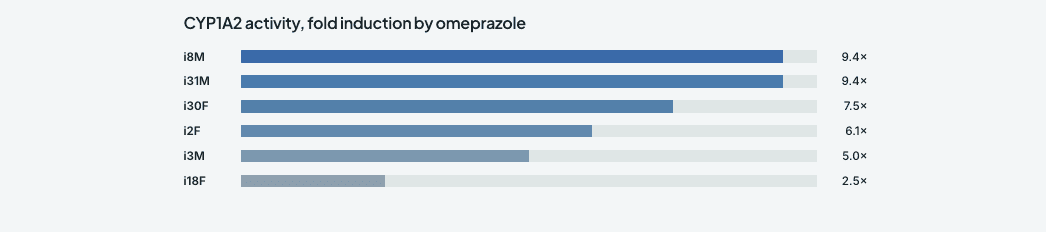
CYP3A4 activity across eighteen Cytochroma iPSC donor lines, spanning a greater than fifty-fold range..
50 μM, 48 h · n=3 per condition
What is Wet AI?
Why do AI-generated compounds need wet-lab validation?
How fast is a Wet AI screen?
Which organ systems can be screened?
How does donor diversity change the result?
What is Cell Painting and why does it matter for prioritisation?
How is the data delivered?
What are Data Lochs?
What evidence is there that these models predict clinical outcomes?
How does this relate to FDA guidance on New Approach Methodologies?
Who runs the screens?
Where is the work carried out?
Request a quote or technical discussion
Tell us your assay format, donor requirements, and timelines. Our scientific team will help select the right donor panel and model configuration.